
About LadderNest — Built By A Connecticut Contractor
LadderNest was designed by a contractor who spent 30+ years in the exterior trades — and got tired of the same problem showing up on every job site.
About LadderNest — The Ladder Stabilizer for Decks
LadderNest is the only purpose-built ladder stabilizer for decks on the market. It was designed by Rich Witzmann — a Connecticut roofing, siding, and exterior contractor with 30+ years on the job — who needed a real solution for setting ladders on customer decks without causing damage.
The Problem Every Exterior Contractor Knows
Every contractor who works exteriors knows the moment. You’re on a job — siding, roofing, windows, painting — and the only place to set the ladder is the customer’s deck. You put a rag under the feet, maybe a piece of cardboard, and hope for the best. Then you pack up and see the damage. Scratches across a Trex board. A gouge in TimberTech. That conversation with the homeowner nobody wants to have.
Why a Ladder Stabilizer for Decks Matters
Composite and PVC decking can’t be sanded or stained to match once damaged. A single ladder foot dragging across a Trex or TimberTech board means a $300–500 repair bill and a customer who never calls back. Rags and cardboard don’t stabilize anything — they just add a layer. The ladder still moves. The deck still gets damaged. What was needed was mechanical retention: something that locks the ladder feet in place and lifts them off the deck surface entirely.
How LadderNest Works
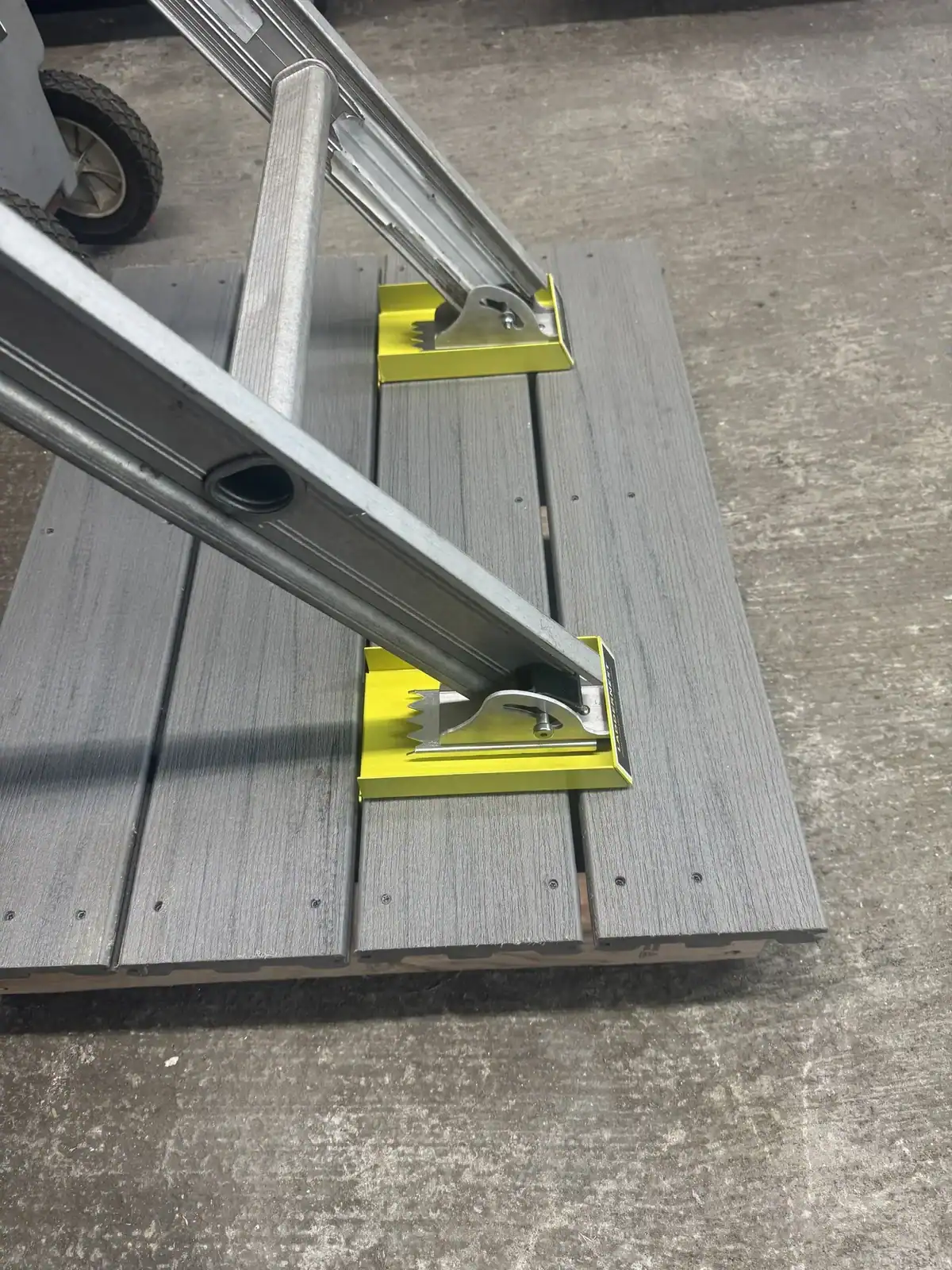
LadderNest drops into the gap between deck boards at the base of the ladder. The ladder feet drop into a three-sided retention channel — captured on all sides, they can’t slide forward, backward, left, or right. The feet sit on the steel platform, completely off the deck surface. Five seconds from truck to climbing. No tools. No fasteners. No damage to explain at the end of the day.
Built to Last a Career
LadderNest is made from contractor-grade 16-gauge AISI 1018 mild steel with Safety Yellow powder coat — so you never leave it on a job site. Patent pending. Sold in pairs. It’s the only ladder stabilizer for decks designed by a contractor, for contractors, and built for real job site conditions. Available at LadderNestPro.com.
The Story
Every contractor who works exteriors knows the moment. You’re on a job — siding, roofing, windows, painting — and your ladder has to go up against the house. The feet land on the customer’s deck.
You do your best to protect it. A rag under the feet. A piece of cardboard. Sometimes nothing at all. And sometimes you pack up at the end of the day and see the damage — scratches, gouges, cracked boards.
That conversation with the homeowner is one nobody wants to have. And for what? There was nothing purpose-built to prevent it.
So I built one.
LadderNest is the ladder stabilizer for decks I wished existed for 30 years. Contractor grade steel. Safety Yellow so you never leave it behind. A three-sided retention channel that captures the ladder feet and protects the deck underneath. Simple. Effective.
Why a Ladder Stabilizer for Decks Matters
Composite and PVC decking has become the standard in residential construction — and it scratches easily. Unlike wood, composite boards can’t be sanded or stained to match once they’re damaged. A single ladder foot dragging across a Trex or TimberTech board can mean a $300–500 repair bill and a customer who never calls you back.
The industry had no real answer to this problem. Rags, cardboard, and rubber mats don’t stabilize anything — they just add a layer between the foot and the surface. The ladder still moves. The deck still gets damaged. What was needed was a mechanical solution: something that locks the ladder feet in place and lifts them off the deck surface entirely. That’s what LadderNest does.
Built By a Contractor
Rich Witzmann has spent over 30 years in the exterior trades — roofing, siding, windows, and decking across Connecticut and New England. LadderNest isn’t a product designed by engineers in a lab. It’s a product designed by someone who has set thousands of ladders on thousands of decks and felt the problem firsthand on every single job.
Every design decision reflects real job site conditions. The 16-gauge steel handles the load. The Safety Yellow finish means it’s impossible to leave behind. The three-sided channel captures both ladder feet in under five seconds, with no tools and no setup. It’s built the way a contractor would build it — because it was.
How LadderNest Works
Step 1 — Drop It Between the Boards
LadderNest drops into the gap between deck boards at the base of the ladder. No fasteners, no modifications to the deck. The steel platform sits between the boards and locks into position under the weight of the ladder.
Step 2 — Set the Ladder Feet In
The ladder feet drop into the three-sided retention channel. They’re captured on three sides — they can’t slide forward, backward, left, or right. The feet sit on the steel platform, completely off the deck surface.
Step 3 — Climb
That’s it. Five seconds from your truck to climbing. No rag to pick up. No cardboard to throw away. No damage to explain to the homeowner at the end of the day.
The LadderNest Difference
Contractors who show up with LadderNest send a message before they say a word. It tells the homeowner that you care about their property — that you came prepared, not hoping for the best. That’s the kind of professionalism that earns referrals and repeat business.
LadderNest is patent pending, made from contractor-grade 16-gauge AISI 1018 steel, and sold in pairs. It’s the only purpose-built ladder stabilizer for decks on the market — designed by a contractor, for contractors, and built to last a career.
Built By A Contractor — For Contractors
30+ years in the exterior trades went into this design. Contractor grade steel. Safety Yellow. Patent Pending.